
Verified
The tablet relieved my familiar exertional chest pressure within several minutes when I was sitting down. The headache was strong at first, so I stopped walking around after taking it and kept the medicine accessible.
18 Oct 2026
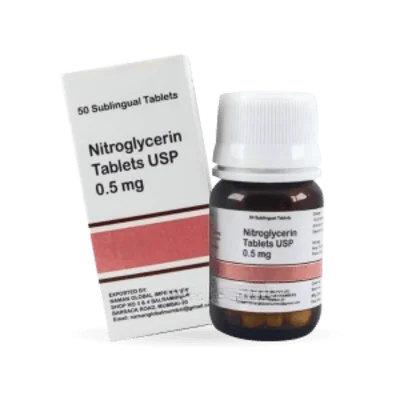
Nitroglycerin is a sublingual nitrate medicine for adults with medically diagnosed angina. It can rapidly relieve or prevent angina by relaxing blood vessels and reducing the heart’s workload.
Nitroglycerin is a nitrate vasodilator used to prevent or relieve angina caused by reduced blood flow to the heart. It is intended for adults with medically diagnosed angina, and the dose is stated on the pack—follow the leaflet; the sublingual tablet acts rapidly by relaxing blood vessels and reducing cardiac workload.
This product contains Nitroglycerin in sublingual tablet form. The exact composition and dose are stated on the pack; follow the leaflet for product-specific information.
The dose is stated on the pack—follow the leaflet. The tablet is placed under the tongue during an angina episode or before a recognised exertional trigger when the prescriber has provided that plan. It is not an oral capsule, swallowed tablet, skin ointment, spray, or intravenous preparation.
Use the prescribed dose as follows:
A commonly used emergency protocol for prescribed sublingual nitroglycerin allows one dose every five minutes, up to three doses, while emergency help is being sought for persistent pain. The exact plan should come from the treating clinician because chest pain may represent myocardial infarction.
If a dose is missed before planned exertion, do not double the next dose. Use the next dose only according to the prescribed plan. Sublingual nitroglycerin is intended for immediate use, not for routine swallowing or unscheduled repeated dosing.
Nitroglycerin, also called glyceryl trinitrate, belongs to the nitrate vasodilator class. The active ingredient releases nitric oxide-related signalling molecules inside vascular smooth muscle. This relaxes the muscle and widens blood vessels, allowing blood to move with less resistance.
The strongest clinical effect occurs in the veins. Venous relaxation reduces the amount of blood returning to the heart, known as preload. The heart then needs less force and oxygen to pump blood. Nitroglycerin also dilates coronary arteries and can reduce coronary spasm, helping improve the balance between oxygen supply and demand in the heart [1].
Glyceryl trinitrate is converted into nitric oxide or related active compounds within the body. These compounds increase cyclic guanosine monophosphate, or cGMP, inside vascular smooth muscle. cGMP lowers muscle contraction and produces vasodilation.
Nitroglycerin is used in cardiology for angina, the pressure or discomfort caused when the heart muscle does not receive enough oxygen-rich blood. Sublingual tablets are designed for rapid relief of an acute angina episode or for use shortly before an activity known to trigger angina, when prescribed for that purpose.
Nitroglycerin may also be used in selected heart-failure treatment plans, mainly because venous dilation reduces cardiac filling pressure. The sublingual 0.5 mg tablet is not a replacement for long-term heart-failure treatment, blood-pressure control, cholesterol management, or antiplatelet therapy.
| Clinical use | Main physiological goal | Expected role |
|---|---|---|
| Acute stable angina | Reduce cardiac oxygen demand and improve coronary blood flow | Rapid symptom relief |
| Predictable exertional angina | Reduce the chance of pain during a known trigger | Preventive dose before prescribed activity |
| Selected heart-failure care | Lower venous return and cardiac filling pressure | Specialist-directed treatment |
Chest pain can have causes other than angina. Pain that is new, severe, prolonged, associated with sweating or breathlessness, or different from the usual pattern requires emergency assessment rather than repeated self-treatment.
As a sublingual approach, Nitroglycerin is intended for rapid relief of an acute angina episode or use before a known trigger. This differs from long-term treatment plans for heart failure, blood pressure, or cholesterol, which address ongoing management rather than immediate symptom relief.
The following situations require avoidance or specialist direction:
Pregnancy and breastfeeding require a clinician-led risk assessment.
Nitroglycerin is not suitable for everyone.
Not for you if you use sildenafil, tadalafil, riociguat, or another contraindicated medicine unless a clinician directs otherwise.
Older adults and people taking several blood-pressure medicines may be more sensitive to dizziness and fainting. People with glaucoma, migraine triggered by vasodilation, kidney disease, liver disease, or recurrent low blood pressure require individual assessment.
Nitroglycerin should not be used to manage chest discomfort of uncertain cause without medical direction.
Headache is the most recognisable adverse effect of nitrate treatment. It may be throbbing, appear soon after the dose, and become less troublesome as the body adapts. Dizziness, flushing, weakness, nausea, blurred vision, and light-headedness can also occur because blood pressure falls.
Fainting is more serious. It may follow a rapid change from sitting to standing or a stronger-than-expected blood-pressure response. Palpitations and changes in heart rate can occur, while severe overdose may lead to marked hypotension, collapse, confusion, breathing difficulty, or circulatory failure.
Nitroglycerin does not produce the classic compulsive drug dependence associated with addictive substances. Tolerance can develop when nitrate exposure is continuous, reducing the response over time. Sublingual dosing for occasional episodes has a different exposure pattern from continuous nitrate therapy. A planned nitrate-free interval is often used with long-acting nitrate regimens to limit tolerance. The prescriber determines whether that approach applies to the formulation and schedule.
A headache can be unpleasant but does not automatically mean that the treatment is unsafe. Severe headache with neurological symptoms, fainting, chest pain that changes character, or severe palpitations requires prompt assessment.
Several practical errors reduce the benefit or increase the risk:
One less obvious mistake is treating the medicine as a preventive substitute for prescribed cardiac therapy. Nitroglycerin can relieve an episode, but it does not replace treatment for hypertension, coronary artery disease, diabetes, or raised cholesterol.
In clinical practice, doctors usually explain that sublingual nitroglycerin is a rescue treatment for a recognised angina pattern, not a general painkiller. Its benefit depends on using it early, while the patient is resting, and following a clear emergency plan.
A cardiologist also looks for a change in pattern. Angina occurring at rest, lasting longer than usual, appearing with less exertion, or accompanied by faintness can indicate an acute coronary syndrome. Relief after nitroglycerin does not prove that the pain was harmless.
The 0.5 mg dose is a specific strength. Patients should not substitute another nitrate product or use a spray, ointment, or swallowed tablet as though it had the same dosing instructions. Different formulations release glyceryl trinitrate through different routes and can produce different blood concentrations.
Nitroglycerin treats the immediate haemodynamic problem. It does not remove a coronary artery blockage, reverse a heart attack, or replace long-term cardiovascular prevention. The American Heart Association and European Society of Cardiology place rapid assessment at the centre of care when symptoms suggest acute coronary syndrome [2].
Nitroglycerin is used to relieve or prevent episodes of stable angina by reducing cardiac oxygen demand and improving coronary blood flow. It may also have a role in selected heart-failure or acute-care settings under specialist direction. The World Health Organization’s 2021 cardiovascular guidance identifies nitrate therapy as part of established cardiovascular pharmacology, while the exact treatment plan depends on the patient’s diagnosis and haemodynamic status [3].
Sublingual absorption begins through the tissues beneath the tongue, so relief may begin within minutes rather than after the slower absorption expected from a swallowed tablet. The response varies with the cause of pain, circulation, timing, and dose. SAHPRA-approved 2024 product information should guide the prescribed regimen, while persistent or worsening pain requires emergency assessment rather than repeated unsupervised dosing.
No. Nitroglycerin must not be combined with sildenafil or tadalafil because both treatments can lower blood pressure through complementary vascular pathways. The FDA’s 2024 prescribing information identifies nitrate and PDE-5 inhibitor co-administration as a serious contraindication, with risks including fainting, myocardial ischaemia, and cardiovascular collapse. Emergency staff must know about recent PDE-5 inhibitor use before giving nitrates.
Persistent pain after the first prescribed dose should be treated as a medical emergency, especially if it is severe, unfamiliar, or associated with sweating, nausea, shortness of breath, or weakness. Do not keep taking tablets indefinitely while waiting for relief. The 2024 FDA prescribing information supports urgent evaluation when symptoms suggest acute coronary syndrome rather than relying on symptom suppression alone [4].
Yes. Headache is a common nitrate-related effect and reflects dilation of blood vessels rather than an allergic reaction in most cases. Resting in a safe position may help with associated dizziness, but severe headache, neurological symptoms, fainting, or an unusual chest symptom requires urgent medical evaluation. The FDA’s 2024 prescribing information supports reviewing persistent problems with the dose, timing, or alternative treatment.
Sublingual nitroglycerin is not normally taken on a fixed daily schedule for an acute episode. If a planned preventive dose is missed, do not compensate with two tablets or take extra doses later. Use the prescribed plan for the next trigger, and seek medical advice when attacks become more frequent, occur with less exertion, or change in character. NICE’s 2016 cardiovascular guidance treats a changing angina pattern as a reason for prompt clinical review [5].
No. Nitroglycerin is intended for a recognised angina plan and does not safely classify the cause of chest pain by itself. Chest pain from a heart attack, pulmonary embolism, aortic disease, reflux, or another condition may need a different emergency response. The American Heart Association’s 2024 guidance recommends emergency assessment for new, severe, persistent, or atypical chest symptoms, even when nitroglycerin provides partial relief.
Your order will be securely packed and shipped within 24 hours. This is exactly what your package will look like (images of an actual item sent). It has the size and look of a regular private letter (24x11x0.7 cm) and its contents cannot be seen.

Nitroglycerin is sensitive to environmental conditions, including heat, moisture, and loss of container protection. Keep the tablets in the storage container supplied for them, closed between uses, and away from excessive heat. Do not transfer them into an ordinary pill organiser unless a pharmacist has confirmed that the container preserves the medicine properly.
A weak tingling sensation under the tongue may occur, but its absence does not prove that the tablet has failed. Symptom response and the prescribed emergency plan are more useful than relying on taste or tingling.
The tablet relieved my familiar exertional chest pressure within several minutes when I was sitting down. The headache was strong at first, so I stopped walking around after taking it and kept the medicine accessible.
I used one tablet before a hill that usually triggered symptoms. It helped, but I felt light-headed when I stood up quickly. Sitting down made the difference.
The first episode did not settle as quickly as expected. I called emergency services instead of taking repeated tablets. The hospital team found that the pain needed further investigation.
Headaches occurred after most doses during the first week. They became milder later, but the treatment plan was reviewed because I was also using several blood-pressure medicines.