Verified
I used a thin layer after rinsing a scraped knee. The ointment stayed in place better than a liquid would have, although I found the skin around the scrape became a little soft under a tight dressing.
07 Oct 2026

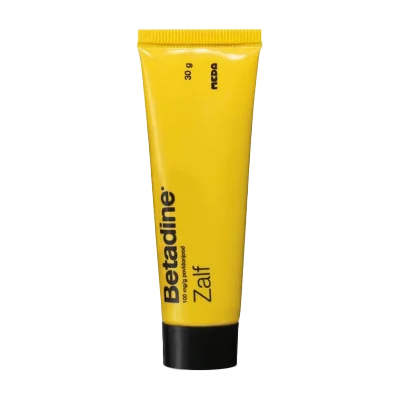
Betadine is a topical antiseptic ointment for small, superficial skin injuries. It is intended for people caring for minor cuts, grazes, abrasions, and limited burns. Applied as a thin film, it helps reduce surface microorganisms and supports clean wound care.
Betadine is a topical antiseptic ointment for minor cuts, grazes, abrasions, and superficial burns. It is applied to the affected skin to reduce surface contamination and support clean wound care. Betadine belongs to the topical antiseptic category.
Betadine is supplied as an ointment in a tube and is intended for external skin use. Its role is local antiseptic care rather than treatment of deep, extensive, or unexplained wounds. The ointment forms a thin protective layer over the treated area while helping reduce exposure to microorganisms from the surrounding environment.
Use is most appropriate for small, superficial skin injuries after gentle cleansing. It may also be used for limited areas of irritated or broken skin when the cause is clear and the affected area is minor.
Topical antiseptics work at the skin surface by reducing microorganisms that may contaminate a wound. This action supports local hygiene during the early care of minor injuries, before a natural skin barrier has fully recovered.
Betadine should not be used as a substitute for wound assessment when bleeding is persistent, tissue is deeply separated, an object is embedded, or the injury followed an animal or human bite. These situations require a different clinical assessment because infection risk and tissue damage may extend below the surface.
Topical antiseptics work at the skin surface by reducing microorganisms that may contaminate a wound. This action supports local hygiene during the early care of minor injuries, before a natural skin barrier has fully recovered.
Betadine ointment is suited to small cuts, superficial grazes, minor abrasions, and limited superficial burns. Clean the area gently before application, removing visible dirt without scrubbing damaged tissue. Pat the skin dry around the wound, then apply a thin layer.
A light covering may be used when the area is exposed to friction or dirt. The dressing should be changed when it becomes wet or dirty. Avoid sealing a heavily contaminated wound under an occlusive covering before it has been cleaned.
Betadine is intended for external skin application. Keep it away from the eyes, inside of the mouth, and other mucosal surfaces unless a healthcare professional has specifically directed that use for the formulation concerned.
Do not apply it repeatedly over large areas without clinical guidance. Broken skin can increase absorption of topical substances, especially when treatment continues for a prolonged period or the skin barrier is widely damaged. Wound-care guidance from the World Health Organization stresses appropriate cleaning, protection, and review of wounds according to their depth and contamination risk [1].
A wound that becomes more painful after initial improvement deserves attention. Spreading redness also warrants review. Fever or red streaking needs prompt medical advice. Reduced movement near the injury is concerning. Seek assessment if any of these signs appear.
Betadine ointment belongs to the topical antiseptic category. Other wound-care approaches have different roles and should not be treated as interchangeable.
| Approach | Main role | Main limitation |
|---|---|---|
| Antiseptic ointment | Local surface antiseptic care for a minor injury | Not suitable for deep, extensive, or unexplained wounds |
| Clean water and gentle covering | Physical removal of dirt and protection during healing | Does not provide a topical antiseptic layer |
| Medical wound assessment | Evaluation of deep, infected, heavily contaminated, or persistent wounds | Requires professional examination |
The advantage of an ointment is targeted application to a small area. It can be useful where a liquid would run away from the wound or be difficult to control. The limitation is equally practical: ointment cannot repair damaged tissue, close a deep wound, remove embedded material, or replace treatment for a developing infection.
Betadine is not suitable for you if you have previously experienced a serious allergic reaction to this product or any of its ingredients. Avoid applying it to the eyes or swallowing it. Do not use it as routine care for large burns, extensive open wounds, or deep injuries without medical direction.
Do not combine several topical antiseptics on the same wound unless directed. Mixing products can increase irritation and makes it harder to identify which preparation caused a reaction.
Use extra caution in these situations:
Most topical antiseptic ointments are used for short periods and on limited areas. Local irritation can occur, including burning, itching, dryness, redness, or a rash. Contact dermatitis may develop after repeated exposure or in someone sensitive to an ingredient.
Stop applying Betadine to the affected area if a new rash, blistering, marked swelling, or intense burning appears. If swelling affects the lips, face, or breathing, seek urgent medical help.
Possible problems include:
The European Medicines Agency describes contact reactions and local irritation as recognised concerns with several topical antiseptic preparations, with risk influenced by the substance, treatment area, and duration of use [2].
One detail patients often miss is the difference between irritation and infection. Irritation usually appears as a surface rash or burning pattern. Infection more often causes progressive pain, warmth, swelling, pus, spreading redness, or systemic symptoms.
Several habits can reduce the value of otherwise sensible wound care:
In clinical practice, doctors usually separate three tasks: cleaning the wound, protecting the wound, and recognising infection. An antiseptic ointment can support the second stage, but it does not replace the first or third.
A clinician would expect a minor wound to show gradual improvement in tenderness, redness, and moisture. Persistent deterioration suggests that the wound needs examination rather than a thicker application. Surgical wound guidance from NICE places emphasis on wound assessment, infection recognition, and appropriate dressing care rather than prolonged routine topical treatment [3].
Doctors also look at the person, not only the skin. Diabetes, circulation problems, immune suppression, steroid therapy, and reduced sensation can change the risk from a small injury. These factors justify earlier assessment even when the wound is short or shallow.
Betadine ointment is intended for local care of minor superficial skin injuries when the wound is small and has been gently cleaned. The World Health Organization published wound-care guidance in 2014 that supports cleaning, protection, and observation as core steps in minor injury care. Apply a thin layer rather than filling the wound with ointment. Deep, gaping, heavily contaminated, or worsening wounds require clinical assessment.
A small superficial burn may be suitable for limited topical care, but the burn should first be cooled with clean, cool running water. NHS first-aid guidance published in 2024 recommends cooling a burn promptly and seeking medical help for larger, deeper, chemical, electrical, facial, or circumferential burns. Betadine should not delay assessment or be used to cover a severe burn at home. Blisters, increasing pain, or pale, white, leathery, or charred skin indicate a need for medical review.
Use a thin layer according to the product’s directions or the schedule provided by a healthcare professional. Avoid repeated heavy applications, since more ointment does not improve the antiseptic effect and can irritate surrounding skin. SAHPRA product information dated 2023 emphasises using topical medicines according to their approved directions and observing for adverse reactions. A missed application should not be replaced with a double layer.
Betadine may support surface antiseptic care, but it should not be relied on as the only treatment for a spreading or established infection. Increasing warmth, swelling, pain, pus, fever, red streaks, or reduced movement can indicate infection requiring examination. WHO wound-care principles from 2014 support early evaluation when local symptoms progress instead of improving. People with diabetes or impaired circulation should seek assessment promptly.
Pregnancy-specific use depends on the formulation, treatment area, duration, and the person’s medical history. Repeated or extensive topical exposure deserves clinical review because absorption through damaged skin can be greater than absorption through intact skin. The EMA evaluates topical antiseptic medicines with attention to exposure and formulation-specific warnings in its 2023 product information. A small, brief application should still follow the product-specific directions, while prolonged treatment should be medically guided.
Children require supervision because they may rub the ointment into their eyes or swallow it from their fingers. Use only on a small external area and prevent licking or repeated touching of the treated site. SAHPRA product information from 2023 should guide age-specific use for the formulation supplied. Seek medical advice for extensive injuries, burns, bites, facial wounds, or wounds that fail to improve.
Your order will be securely packed and shipped within 24 hours. This is exactly what your package will look like (images of an actual item sent). It has the size and look of a regular private letter (24x11x0.7 cm) and its contents cannot be seen.
I used a thin layer after rinsing a scraped knee. The ointment stayed in place better than a liquid would have, although I found the skin around the scrape became a little soft under a tight dressing.
The cut was shallow and stopped bleeding quickly. Betadine was easy to apply, but it stung for a short time. The main improvement came from keeping the area clean and covered.
The wound did not improve as expected and the redness spread slightly. I had diabetes, so I stopped relying on home treatment and arranged an assessment. The ointment was not the main issue; waiting too long was.
A very small amount was enough. I initially applied too much and the skin stayed damp under the dressing, so I changed to a thinner layer and more frequent dressing checks.